Rubber Molds and Dies: Types, Design and Industrial Applications
Rubber molds and dies are essential tools used to shape, form, extrude and cut rubber components. This guide explains the main rubber mold types, their design principles, advantages, limitations and industrial applications, helping manufacturers, engineers and purchasing specialists select suitable rubber tooling for each production process.
Rubber products are manufactured in an enormous variety of shapes, sizes and material grades. A small precision seal, a reinforced diaphragm, an automotive weatherstrip and a large industrial gasket require very different processing methods. However, they all depend on properly designed tooling to achieve the required dimensions, surface quality and functional performance.
Rubber molds and dies define the geometry of a product and influence many other aspects of manufacturing, including cycle time, material consumption, flash formation, process stability and automation potential. Tooling quality can also affect vulcanization uniformity, dimensional accuracy and the frequency of production defects.
The term rubber tooling covers several categories of production equipment. Compression molds, transfer molds and injection molds are used to shape and vulcanize rubber inside closed cavities. Extrusion dies continuously form uncured rubber into profiles, tubes and other long products. Cutting dies do not mold rubber but cut sheets, rolls or blanks into specified shapes.
Understanding the differences among these tools is essential when selecting a manufacturing process or ordering new rubber manufacturing molds.
What Are Rubber Molds and Dies?
A rubber mold is a precision tool containing one or more cavities that reproduce the shape of a finished component. Uncured rubber is introduced into the tool, where heat, pressure and time cause the material to flow and vulcanize. After curing, the mold opens and the finished part is removed.
A die performs a different function. In rubber extrusion, a die shapes a continuous stream of material as it leaves the extruder. In converting operations, a cutting die separates components from rubber sheets or cuts blanks that will be used in subsequent processes.
Although the words “mold” and “die” are sometimes used interchangeably, their functions are not identical:
- A mold forms individual parts inside enclosed cavities.
- An extrusion die forms a continuous profile through an opening.
- A cutting die cuts material to a required two-dimensional contour.
Every type of rubber tooling must be designed around the manufacturing process, compound behavior, production volume and quality requirements.
Main Types of Rubber Molds and Dies
The principal rubber mold types and dies used in industrial manufacturing are:
- Compression molds
- Transfer molds
- Injection molds
- Extrusion dies
- Cutting dies
Each category has its own method of handling rubber, controlling material flow and producing the final geometry. Choosing the correct option requires balancing tooling cost, productivity, waste, part complexity and dimensional requirements.
Compression Molds
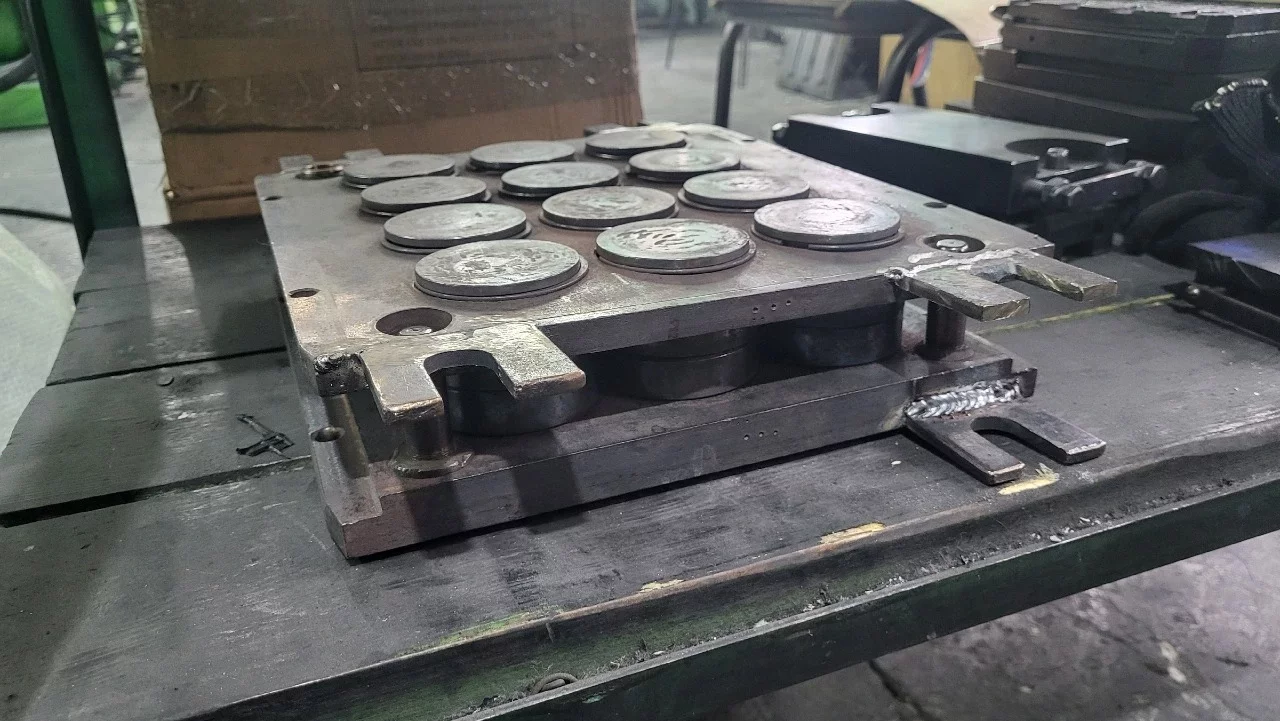
Compression molding is one of the oldest and most widely used methods of manufacturing molded rubber products. A measured quantity of uncured compound, often called a preform or charge, is placed directly into an open mold cavity. The mold is then closed in a heated press.
As pressure is applied, the rubber softens, fills the cavity and begins to vulcanize. Excess material escapes through the parting line and forms flash, which must usually be removed after molding.
Compression Mold Construction
A basic compression mold consists of an upper plate and a lower plate containing matching cavity geometry. Depending on the product, the tool may also include:
- Guide pins and bushings
- Inserts or removable cores
- Overflow grooves
- Flash lands
- Heating channels
- Ejector systems
- Replaceable cavity components
Single-cavity molds are suitable for large parts or limited production, while multi-cavity tools can increase output for smaller components.
Advantages of Compression Molds
Compression molds are generally simpler and less expensive than transfer or injection tooling. They are often a practical choice for low and medium production volumes, large components and products with relatively straightforward geometry.
Other benefits include easy loading of metal inserts, suitability for a wide range of elastomers and lower initial investment in tooling and machinery.
Limitations of Compression Molding
The process often requires manual preparation and placement of preforms. Cycle times may be longer, and material distribution can vary if the charge has an unsuitable weight or shape.
Compression molding may also generate significant flash. Dimensional consistency can be lower than with well-controlled injection molding, especially when producing complex, thin-walled or high-precision parts.
Typical Applications
Compression molds are commonly used for:
- Gaskets and seals
- Vibration isolators
- Rubber pads and mats
- Bushings
- Diaphragms
- Large O-rings
- Rubber-to-metal components
- Low-volume industrial parts
Transfer Molds
Transfer molding combines some characteristics of compression and injection molding. The uncured rubber charge is placed into a separate chamber, often called a transfer pot. A plunger forces the material through sprues and runners into closed mold cavities.
Because the cavities are already closed before the rubber enters them, transfer molding can provide better control over part dimensions and insert positioning than conventional compression molding.
Transfer Mold Construction
Transfer molds generally contain:
- A transfer pot
- A plunger
- Sprues and runners
- Gates
- Mold cavities
- Venting channels
- Flash grooves
- Ejection or stripping features
The feed system must distribute the rubber evenly among the cavities. Poorly balanced runners can produce underfilled cavities, inconsistent cure conditions and variations in part weight.
Advantages of Transfer Molds
Transfer molding is well suited to complex parts, components containing delicate inserts and products requiring better dimensional consistency. The process can fill detailed cavities more effectively than compression molding.
It may also reduce flash around the component, although cured waste remains inside the transfer pot, runners and sprues.
Limitations of Transfer Molding
Transfer molds are more complicated and expensive than basic compression molds. They generate additional material waste because the rubber left in the pot and runner system is normally cured and cannot be returned directly to the process.
The rubber compound must also have suitable flow characteristics. If it begins to cure too early, it may restrict cavity filling and create defects.
Typical Applications
Transfer molds are often selected for:
- Rubber-to-metal bonded parts
- Electrical components
- Seals with inserts
- Complex diaphragms
- Precision grommets
- Encapsulated components
- Medium-volume technical products
Injection Molds
Rubber injection molding uses a machine to plasticize and meter a controlled quantity of compound before injecting it under pressure into a closed, heated mold. The process offers a high level of automation and is particularly suitable for medium- and high-volume production.
Unlike thermoplastic injection molding, rubber injection molding includes vulcanization inside the mold. The tooling and processing parameters must therefore account for the curing behavior of the elastomer.
Injection Mold Construction
A rubber injection mold may include:
- Multiple precision cavities
- Sprues, runners and gates
- Cold-runner or hot-runner systems
- Venting channels
- Vacuum connections
- Thermal control passages
- Ejector pins or stripping plates
- Cores, slides and interchangeable inserts
- Insulation plates
The mold must withstand repeated thermal and mechanical loads while maintaining alignment and dimensional stability.
Advantages of Injection Molds
Injection molding offers short, repeatable production cycles and accurate control over shot size. Automated feeding reduces the need to prepare individual preforms. It can also improve consistency between molding cycles and minimize operator-dependent variation.
Multi-cavity injection molds can achieve high productivity. When combined with an optimized runner system and effective process control, they may reduce flash, improve dimensional repeatability and lower labor costs per part.
Limitations of Injection Molding
Injection molds and machines require substantial initial investment. Mold design is more demanding because rubber viscosity, scorch safety, curing behavior and flow balance must be considered together.
The process may be uneconomical for small production batches. Maintenance requirements can also be greater, particularly for advanced molds with vacuum systems, runner technology, slides or complex ejection mechanisms.
Typical Applications
Injection molds are widely used for:
- Automotive seals and boots
- Precision O-rings
- Medical and technical components
- Electrical connectors
- Cable seals
- Membranes
- High-volume rubber-to-metal parts
- Complex industrial seals
Extrusion Dies
An extrusion die continuously shapes uncured rubber as it exits a rubber extruder. The compound is transported and conditioned by the screw, then forced through an opening whose geometry corresponds approximately to the required profile.
The word “approximately” is important because rubber does not always retain the exact shape of the die opening. Elastic recovery causes the extrudate to expand or change shape after leaving the die. This behavior is commonly known as die swell.
Extrusion Die Construction
Rubber extrusion dies may be used to produce:
- Solid profiles
- Hollow profiles
- Tubes and hoses
- Sealing strips
- Edge trims
- Cable coverings
- Multiple-material profiles
- Profiles with metal or textile reinforcement
A typical die assembly can include a die plate, flow channels, mandrels, bridges, supporting elements and adjustment mechanisms. Hollow products require internal tooling to form the bore.
Extrusion Die Design Considerations
The geometry of an extrusion die cannot simply duplicate the final cross-section. Designers must compensate for compound elasticity, pressure distribution, shrinkage during curing and differences in flow through thick and thin sections.
Flow must reach all areas of the die opening at a balanced rate. If one part of the profile moves faster than another, the extrudate may twist, curve or lose dimensional stability.
The design process should consider:
- Compound viscosity
- Extruder size and output
- Die swell
- Profile wall thickness
- Vulcanization method
- Line speed
- Required tolerances
- Expected cooling shrinkage
- Reinforcement and co-extrusion requirements
Many extrusion dies require production trials and final adjustments before they consistently deliver the specified profile.
Typical Applications
Extrusion dies are used for the continuous production of:
- Automotive weatherstrips
- Window and door seals
- Industrial sealing profiles
- Rubber hoses
- Rubber tubing
- Sponge rubber profiles
- Cable insulation
- Conveyor belt components
- Construction seals
Cutting Dies
Cutting dies are used to cut rubber sheets, rolls, slabs or laminated materials into finished components or molding blanks. Unlike compression, transfer and injection molds, they do not normally shape rubber through pressure-driven flow inside a cavity.
The cutting process can be carried out with mechanical, hydraulic or automated presses.
Main Cutting Die Designs
Steel-rule dies are made by bending a sharpened steel strip to the required contour and mounting it in a supporting base. They are economical and suitable for many gasket and sheet-converting operations.
Solid-machined dies are manufactured from tool steel or another durable material. They provide greater rigidity, accuracy and wear resistance for demanding applications and long production runs.
Punch-and-die systems use matching male and female components to shear material. They are suitable when accurate edges and consistent dimensions are required.
Rotary dies use cylindrical tooling to cut products continuously from sheet or roll material. They offer high productivity in automated manufacturing lines.
Advantages of Cutting Dies
Cutting dies offer fast production, relatively simple operation and efficient nesting of flat components. Tooling costs may be considerably lower than those of cavity molds, especially for simple shapes.
They are suitable for manufacturing parts from cured rubber sheet, uncured compound, sponge materials, reinforced laminates and adhesive-backed rubber.
Limitations of Cutting Dies
Cutting dies are mainly limited to flat or nearly flat products. Material thickness, hardness and reinforcement can affect edge quality and dimensional accuracy.
Rubber may deform during cutting and recover after the load is removed. Therefore, the die dimensions may need to compensate for elastic movement. Tool wear can also lead to rough edges, incomplete cuts and gradual dimensional change.
Typical Applications
Cutting dies are frequently used for:
- Flat gaskets
- Washers
- Insulation pads
- Rubber spacers
- Sealing rings
- Adhesive-backed parts
- Molding preforms
- Fabric-reinforced components
Comparison of Rubber Tooling Types
Compression molds are usually the most economical cavity tools and are well suited to simple products, large parts and lower production volumes. However, they may have longer cycles and produce more flash.
Transfer molds provide improved filling of complex cavities and better control of inserts. They require a runner system and usually produce cured waste in the pot and feed channels.
Injection molds support automation, short cycles and high-volume manufacturing. They offer excellent process repeatability but require greater investment and more advanced design.
Extrusion dies are the correct choice for continuous products with a constant cross-section. Their performance depends heavily on flow balance and compensation for die swell.
Cutting dies are designed for flat components and blanks made from sheet or roll material. They can achieve very high productivity but cannot replace cavity molds for three-dimensional parts.
Key Principles of Rubber Tooling Design
Regardless of the tooling category, effective design begins with a clear understanding of the rubber compound and production process. Rubber is elastic, temperature-sensitive and time-dependent. Its behavior cannot be evaluated only by using the final dimensions of the product.
Material Flow
The tool must allow the rubber to reach all required areas without premature curing, trapped air or excessive pressure. Thin sections, sharp changes in direction and long flow paths increase filling difficulty.
Runner and gate dimensions must be matched to compound viscosity and part geometry. For extrusion dies, internal channels should distribute the compound evenly across the profile.
Shrinkage
Rubber products normally shrink after vulcanization and cooling. The amount of shrinkage depends on polymer type, formulation, curing temperature, product geometry and process conditions.
Mold cavities are therefore manufactured larger than the nominal finished dimensions. Applying a generic shrinkage factor without testing the actual compound may lead to unacceptable dimensional errors.
Venting
Air and volatile substances must escape during cavity filling and curing. Insufficient rubber mold venting can cause burns, short shots, trapped air, surface defects and weak areas.
Vents are commonly positioned at the last points to fill. They must be deep enough to release gas but shallow enough to prevent excessive rubber flow and flash.
Parting Lines
The parting line determines how the tool opens and where flash may form. Its location affects product appearance, dimensional control and deflashing requirements.
An effective parting line should simplify machining and removal while avoiding critical sealing or cosmetic surfaces whenever possible.
Temperature Control
Uniform tool temperature is essential for consistent vulcanization. Cold areas may produce undercured rubber, while hot areas may cause premature curing or non-uniform properties.
Heating channels or electric heaters should be arranged to minimize temperature differences across the working surface. Insulation can help reduce heat loss to the press.
Demolding and Ejection
Rubber parts may stretch, grip cores or remain inside deep cavities. Tool designers must provide adequate draft, accessible stripping areas and a suitable ejection method.
Ejector pins, stripping plates, compressed air and removable cores may be used. The selected method must remove the part without tearing, distortion or unacceptable marks.
Materials Used for Rubber Molds and Dies
Tooling material selection depends on production volume, operating temperature, pressure, rubber formulation and required service life.
Common materials include carbon tool steels, pre-hardened mold steels, alloy steels, stainless steels and aluminum. Hardened tool steel is often selected for long production runs and abrasive compounds. Stainless steel may be beneficial when corrosion resistance is important. Aluminum offers excellent thermal conductivity and easy machining, making it useful for prototypes and some limited-production tools.
Surface treatments and coatings can improve wear resistance, corrosion protection and release performance. Options may include nitriding, hard chrome plating and engineered surface coatings. The treatment must remain compatible with the elastomer and production environment.
Common Tooling Defects and Their Causes
Tool-related and process-related problems are often connected. A defect may result from cavity geometry, venting, thermal imbalance, material preparation or machine settings.
Common issues include:
- Excessive flash: worn parting surfaces, excessive charge weight or inadequate clamping force.
- Short filling: restricted gates, poor material flow, low injection pressure or premature curing.
- Air traps: insufficient venting or unsuitable cavity orientation.
- Surface burns: compressed gases, excessive temperature or high filling speed.
- Flow marks and weld lines: unbalanced material flow or poorly positioned gates.
- Dimensional variation: incorrect shrinkage allowance, unstable temperature or inconsistent curing.
- Difficult demolding: insufficient draft, rough surfaces or unsuitable ejection.
- Distorted extrusions: poor die balance, inconsistent temperature or non-uniform exit velocity.
- Rough cut edges: worn cutting blades, incorrect clearance or unsuitable support beneath the material.
Systematic troubleshooting should evaluate the tooling, compound and process as a connected system rather than focusing on a single factor.
How to Choose the Right Rubber Tooling
The choice of rubber molds and dies should begin with the product geometry and production method. A continuous weatherstrip requires an extrusion die, while a three-dimensional seal requires a cavity mold. A flat gasket can often be produced efficiently with a cutting die.
Production volume is another major factor. Compression molds may be cost-effective for short runs, while injection tooling can provide a lower unit cost in high-volume production despite its higher initial price.
Buyers and engineers should also evaluate:
- Rubber compound and hardness
- Part dimensions and tolerances
- Annual production quantity
- Required cycle time
- Number of cavities
- Insert molding requirements
- Acceptable flash level
- Surface finish
- Vulcanization method
- Level of automation
- Tool maintenance requirements
- Available molding or extrusion equipment
The tooling supplier should receive complete product drawings, compound data, dimensional tolerances, estimated order volumes and quality requirements. Providing incomplete information early in the project often causes expensive modifications later.
Tool Validation and Maintenance
Before full-scale production begins, new rubber tooling should be tested under realistic process conditions. Trial runs help confirm cavity filling, dimensional shrinkage, temperature uniformity, venting efficiency and demolding behavior.
Initial samples should be inspected for dimensions, appearance and functional performance. Process parameters and tool modifications should be documented so that approved conditions can be reproduced.
Routine maintenance is equally important. Rubber residues, cured deposits and release agents can block vents or affect surface quality. Parting surfaces, gates, runners, cutting edges, guides and ejectors should be inspected regularly.
Proper cleaning, corrosion protection and controlled storage extend service life and reduce unexpected downtime. Maintenance intervals should reflect the production volume, compound type and observed wear.
Industrial Applications of Rubber Molds and Dies
Rubber tooling supports manufacturing in almost every major industrial sector.
In the automotive industry, it is used for seals, hoses, boots, vibration-control components and weatherstrips. Aerospace applications include specialized gaskets and components designed for demanding temperatures and fluids. Medical manufacturers use precision molds for seals, membranes and other technical elastomer parts.
Construction companies depend on extrusion dies for glazing seals, expansion-joint profiles and waterproofing systems. Electrical and electronics manufacturers use molded rubber for insulation, cable sealing and protective components. Food-processing, pharmaceutical and chemical industries require tooling capable of producing hygienic seals from application-specific compounds.
This variety explains why rubber tooling cannot be standardized around a single design. Each project requires a combination of product knowledge, material understanding and manufacturing expertise.
Conclusion
Rubber molds and dies determine much more than the external shape of a product. They influence material flow, vulcanization, cycle time, dimensional stability, waste generation and long-term production cost.
Compression molds provide a practical and economical solution for many simple or low-volume products. Transfer molds improve the filling of detailed components and accommodate inserts effectively. Injection molds offer automation and repeatability for high-volume manufacturing. Extrusion dies continuously form profiles, hoses and tubing, while cutting dies efficiently produce flat parts from rubber sheet.
Selecting appropriate rubber tooling requires careful consideration of compound behavior, geometry, tolerances, production volume and available equipment. When these factors are addressed during design, rubber manufacturing molds and dies can provide reliable quality, higher productivity and a longer working life.
Supplier Sourcing Support
If you are looking for a solution in the rubber industry—whether for equipment, materials, finished products, or molds—please provide a detailed description of your requirements. Your request will be forwarded to relevant suppliers and technical specialists, allowing you to select the best option from those proposed.
Exhibition Invitation
We, Industrial Technology Exhibition, invite you to participate in the Rubber and Elastomers exhibition. Whether you're a guest or a resident company, if you have something interesting to share with our colleagues, we'll be happy to feature you on the platform. Connect, find new useful contacts, and share the latest information!
Related publications
Rubber Injection Mold Design: Key Principles, Materials and Common Defects
This practical guide explains how to design reliable rubber injection molding tooling, from runner and gate geometry to cavity arrangement, mold venting, thermal control, shrinkage compensation and part removal. It also examines common rubber mold defects and shows how design decisions can improve consistency, productivity and tool life.
Read article
Rubber Injection Molding vs Compression Molding vs Transfer Molding
Rubber injection molding, compression molding, and transfer molding each offer different advantages in production speed, tooling investment, material efficiency, and part quality. This guide compares the three main rubber molding methods to help manufacturers select the most suitable process for their products, materials, and production volumes.
Read article
Comments 0